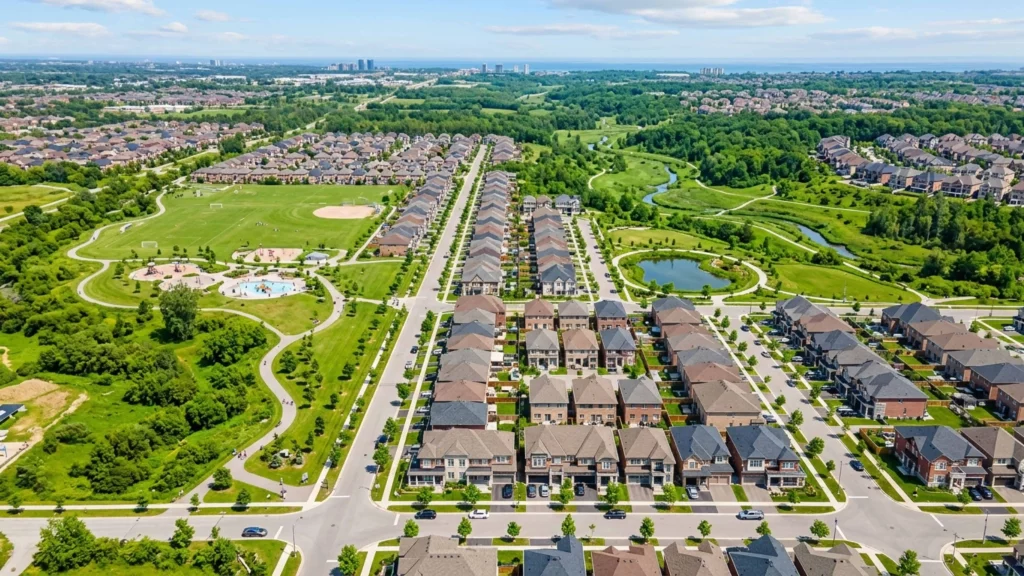
Oakville’s best neighbourhoods include Old Oakville, Glen Abbey, Bronte, Palermo Village, and Joshua Creek, each offering a distinct character, price tier, and lifestyle profile. Whether the priority is waterfront access, golf course adjacency, heritage architecture, or new build quality, Oakville has a defined pocket for it.
Why Oakville Neighbourhood Selection Requires a Sharper Lens
Oakville is not a market where neighbourhood choice is casual. The city sits at the upper end of the regional prestige spectrum, and the price differential between a strong purchase and an average one often comes down to understanding which pocket of Oakville actually aligns with what a buyer needs.
The city’s geography spans from the Lake Ontario waterfront northward through established mid-century communities and into newer planned subdivisions approaching the Oakville-Milton boundary. Each corridor has its own pricing logic, buyer demographic, and long-term trajectory.
For agents working this corridor, the real estate brokerage Oakville segment requires neighbourhood fluency that takes genuine time to develop. Buyers operating at Oakville’s price points research extensively before contacting anyone, and the agent who cannot match that depth in the first conversation rarely gets a second one.
The Neighbourhoods That Define Oakville’s Market Character
Old Oakville
Old Oakville is the city’s most historically significant residential area and its clearest prestige address. The neighbourhood runs along the Lake Ontario shoreline and into the established streets surrounding Oakville Harbour, where heritage Victorian and Edwardian architecture sits alongside carefully designed modern builds.
The buyer profile here attracts executives, established business owners, and buyers relocating from central Toronto who want to preserve a walkable lifestyle while gaining space and waterfront community character. Heritage designation frameworks limit demolition in certain pockets, keeping inventory genuinely scarce. That scarcity supports pricing in ways that newly developed areas cannot replicate.
Glen Abbey
Glen Abbey occupies a specific position in Oakville’s market: premium suburban living built around the famous Glen Abbey Golf Club. Housing ranges from well-maintained detached homes from the 1980s and 1990s through to larger builds on estate-sized lots backing the course.
The buyer demographic skews toward families with school-age children and established professionals who prioritize community character. School catchments in Glen Abbey are consistently strong. One consideration buyers should address: the golf course’s future use has been subject to municipal planning discussions, and current due diligence on development proposals in that study area is worthwhile before committing.
Bronte
Bronte functions as Oakville’s village-within-a-city, anchored by Bronte Harbour, the Heritage Waterfront Park, and a main street with genuine neighbourhood identity. Housing stock includes older cottage-style homes near the harbour, post-war bungalows throughout the interior, and newer infill builds where older properties have been replaced.
That mix creates a wide price range within a geographically compact area. Bronte GO Station provides direct rail access that many competing Oakville neighbourhoods cannot match, making it the strongest commuter option in the city. Investors tracking Oakville’s appreciation story should note that the gap between dated and updated properties in established Bronte pockets supports renovation investment meaningfully.
Palermo Village
Palermo Village represents newer Oakville done with planning intelligence. The neighbourhood was developed with a mixed-use village concept that embedded retail and community services within the residential fabric rather than separating them at the periphery.
The buyer here is typically younger than the Glen Abbey or Old Oakville demographic. Dual-income professional households and families entering the upper-mid ownership tier find Palermo Village compelling. Buyers relocating from Vaughan’s family-oriented communities often find Palermo’s planning logic familiar while gaining a distinct Oakville address.
Joshua Creek
Joshua Creek is Oakville’s most celebrated planned community. Developed primarily in the 1990s and early 2000s with consistent architectural guidelines and integrated green space along the Sixteen Mile Creek corridor, the neighbourhood holds its quality remarkably well.
Iroquois Ridge High School’s French Immersion program has made Joshua Creek a particular draw for families with specific educational priorities. That school catchment factor drives demand that creates a pricing floor insulating the neighbourhood from broader market softness.
Grow Your Real Estate Career at RE/MAX Millennium
Get hands-on training, full marketing and admin support, and access to a powerhouse network across the GTA.
How Oakville Compares to Regional Alternatives
Buyers arriving at Oakville have typically worked through a comparison set that includes other significant GTA communities.
Toronto’s most affluent neighbourhoods offer comparable prestige but at urban density and price-per-square-foot levels that push many buyers westward. Oakville delivers waterfront access, strong schools, and genuine community character at lower absolute prices than comparable Toronto addresses.
Mississauga’s best neighbourhoods compete for buyers who want western GTA positioning at a lower price threshold. The Oakville buyer has typically concluded that the prestige differential and lifestyle quality justify the gap. Brampton serves a different buyer segment, though it appears in early-stage broad GTA affordability searches before buyers narrow their focus.
Tracking broader Toronto real estate market trends helps contextualize Oakville’s cycle timing. When core Toronto inventory tightens, Oakville benefits from accelerated buyer migration within a short lag period, a relationship agents can use to advise clients on market entry timing.
Buyers who begin their search in Oakville’s broader neighbourhood landscape often find themselves drawn toward the city’s upper price tier once they understand what the premium actually delivers. For those specifically evaluating estate character, waterfront proximity, and the status dynamics of Oakville’s top addresses, a dedicated breakdown of the rich neighbourhoods in Oakville covers that segment in full detail.
What Agents Need to Operate Effectively in Oakville
Oakville is a market where generalist approaches underperform consistently. Buyers at this price level test an agent’s local knowledge early in the relationship, and surface-level familiarity does not survive that conversation.
Effective Oakville agents articulate specific tradeoffs between Old Oakville and Bronte for a waterfront-oriented buyer. They understand the Glen Abbey planning context. They know which streets in Joshua Creek back the creek corridor and command premiums versus those with backing lot configurations that affect resale positioning.
That depth does not come from MLS access alone. It comes from market immersion and a brokerage environment that prioritizes agent development. For agents evaluating where to build their Oakville or broader Halton Region practice, the brokerage decision shapes the ceiling more than most initially appreciate.
A well-resourced top real estate brokerage with strong brand presence and training infrastructure in the Halton corridor gives agents a credibility baseline that accelerates trust-building with the sophisticated buyers this market produces. The commission structure conversation matters, but it is secondary to the infrastructure question.
Frequently Asked Questions
Joshua Creek and Glen Abbey consistently rank highest for families, with Joshua Creek earning particular recognition for its school catchment quality and integrated green space along the creek corridor.
For buyers who prioritize waterfront proximity, walkability, and heritage character, Old Oakville consistently delivers value that justifies its pricing. Constrained supply in heritage-designated pockets also supports long-term price stability.
Bronte’s GO Station access makes it Oakville’s strongest option for buyers who require regular rail commuting. Oakville GO near the downtown core also serves Old Oakville and Kerr Village residents.
Oakville’s combination of waterfront access, elite school infrastructure, limited developable land, and sustained buyer demand from Toronto markets positions it as one of the more defensible luxury suburban markets in the GTA over medium to long holding periods.
Final Perspective
Old Oakville, Glen Abbey, Bronte, Palermo Village, and Joshua Creek each represent a distinct version of what Oakville offers. The right choice depends entirely on what the buyer is optimizing for: lifestyle, school catchment, commute geometry, or long-term appreciation potential.
For agents, Oakville rewards deep market knowledge and penalizes surface-level familiarity. Building a credible practice here means investing in local expertise inside a brokerage that takes agent development seriously, because the buyers in this market will demand nothing less.