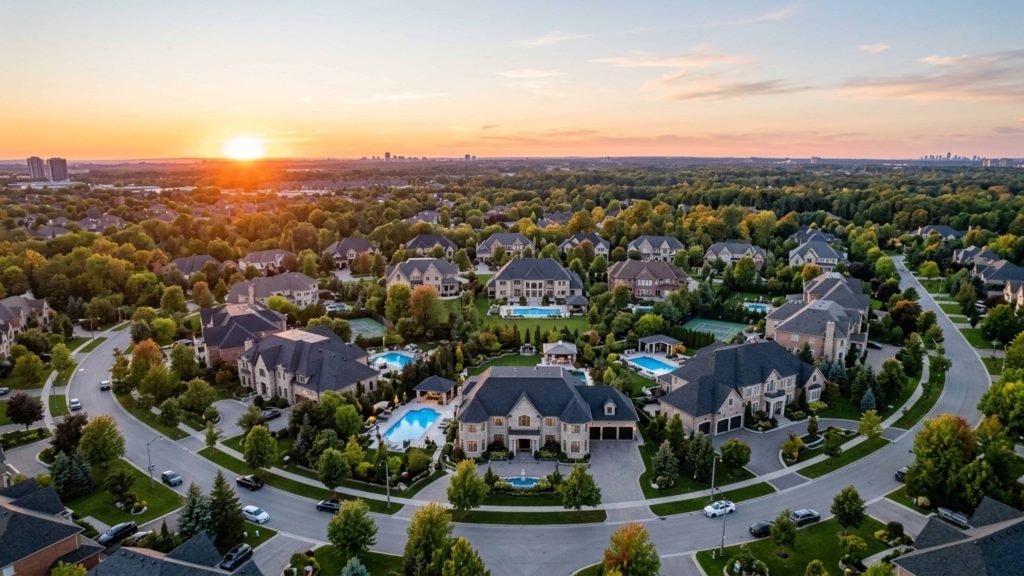
Vaughan’s wealthiest neighborhoods include Kleinburg, Woodbridge, Maple, and Thornhill Woods, each offering distinct price points, lifestyle profiles, and buyer demographics. These areas consistently attract high-net-worth households, making them among the most competitive micro-markets in the Greater Toronto Area.
Why Vaughan’s Luxury Real Estate Market Deserves Serious Attention
Vaughan has evolved from a suburban extension into a self-sustaining city with genuine prestige. The combination of master-planned communities, low-density estate pockets, proximity to major transit corridors, and top-tier school zones has created a real estate landscape where affluence is concentrated in identifiable pockets rather than scattered across the municipality.
For buyers, knowing which neighborhoods offer long-term value, lifestyle alignment, and appreciating assets is the core question. For agents working with real estate brokerages in Vaughan, understanding these micro-markets at a granular level is what separates top producers from order-takers.
The Wealthiest Neighborhoods in Vaughan: A Breakdown
Kleinburg
Kleinburg is consistently cited as Vaughan’s most prestigious address. The neighborhood operates as a semi-rural enclave with large estate lots, custom builds, and a village character that insulates it from the density creeping into other parts of Vaughan.
Buyers here are typically move-up purchasers or relocating executives. Properties regularly exceed $2.5 million, with some custom estates well above that range. The demand profile leans toward families prioritizing privacy, space, and long-term ownership rather than quick appreciation plays.
What agents working in Kleinburg need to understand: buyers here research deeply before contacting anyone. They’ve already toured the village, scoped the school catchments, and benchmarked recent comparables. Showing up without hyper-local knowledge is a credibility gap that’s hard to recover from mid-conversation.
Woodbridge
Woodbridge represents Vaughan’s largest and most established wealthy community. The area carries a strong owner-operator and business owner demographic, with multi-generational families concentrated in specific pockets near Islington Avenue and Rutherford Road.
Price ranges vary significantly by sub-section. The luxury segment in Woodbridge can overlap with Kleinburg pricing, though the lot sizes and build types differ. Semi-detached inventory still exists in transitional areas, which creates confusion for buyers unfamiliar with Woodbridge’s internal geography.
Families researching Vaughan often start with Woodbridge because of its community density and service infrastructure. Connecting those searches to local content about families exploring Vaughan’s top neighborhoods helps agents capture intent early in the buyer journey.
Maple
Maple sits at the intersection of affordability and aspiration within the Vaughan luxury spectrum. It offers newer builds, strong transit access with the Maple GO Station, and neighborhood planning that appeals to younger affluent buyers entering the upper-mid range of the market.
The buyer profile in Maple skews younger than Kleinburg or Woodbridge. Dual-income households in professional sectors dominate the purchase demographic. This matters for listing strategy: staging decisions, digital marketing angles, and feature callouts should reflect that profile rather than defaulting to generic luxury signaling.
Thornhill Woods
Thornhill Woods is Vaughan’s most polished planned community, with a consistent streetscape, golf course adjacency, and proximity to both Yonge Street and Highway 400 corridors. The neighborhood attracts buyers who want the curated suburb feel without sacrificing connectivity.
Inventory turnover here tends to be lower than other Vaughan neighborhoods, which creates longer buying cycles and intensified competition when quality listings do hit the market. Buyers who don’t have strong agent relationships often miss suitable properties entirely.
What Actually Drives Buyer Decisions in Vaughan’s Rich Neighborhoods
Buyers operating at this price point aren’t responding to generic listing copy. Several non-negotiables consistently shape decisions:
School catchment specificity.
Not the general rating, the specific school and its programming. Parents moving into the $1.5 million to $3 million range have typically researched IB programs, French immersion waitlists, and extracurricular infrastructure at depth.
Commute geometry.
The premium Vaughan buyer often has a Bay Street or Financial District destination. They want transit-adjacent luxury, not transit-dependent affordability. The difference matters for how properties are positioned and marketed.
Community density controls.
Buyers paying top dollar in Kleinburg or Thornhill Woods are buying the density constraint as much as the home. Future development risk in surrounding parcels is a real consideration that sophisticated buyers raise during due diligence.
Resale trajectory.
High-net-worth buyers at this level often carry strong analytical frameworks. Showing recent comparable appreciation trends versus adjacent markets like Markham strengthens the investment narrative.
Grow Your Real Estate Career at RE/MAX Millennium
Get hands-on training, full marketing and admin support, and access to a powerhouse network across the GTA.
How This Maps to Agent Opportunity
Understanding the buyer profile in Vaughan’s rich neighborhoods isn’t just informational. It directly informs how agents should be positioning themselves, which brokerages they align with, and what kind of marketing infrastructure they need behind them.
Buyers in these segments expect agents who can cite specific streets, explain infrastructure timelines, and navigate complex negotiations without escalating back to a manager for every decision. That kind of competence doesn’t happen by accident. It develops inside brokerages where training, market data, and agent support infrastructure are structured around performance.
Agents considering where to build their luxury market career in this region would benefit from understanding what separates a best real estate brokerage to work for in Vaughan from one that simply has a recognizable brand on the sign.
The infrastructure difference is significant. Back-office support, marketing collateral quality, CRM workflows, and listing exposure systems all affect how quickly a new agent in a premium market can start operating at the level buyers expect.
Vaughan vs. Adjacent Markets: Where Does the Luxury Buyer Go?
Vaughan isn’t competing with the entire GTA. Its real competition for the luxury buyer is a handful of adjacent markets:
Thornhill (York Region side) offers similar demographics with slightly different price dynamics. Some buyers straddle the Vaughan/Thornhill boundary depending on school preference.
Markham competes directly for the tech sector buyer. The presence of major corporate campuses shifts the buyer demographic toward specific professional sectors, which affects both pricing and property type preferences.
Richmond Hill occupies a transitional position, offering some Vaughan-adjacent luxury with a distinct community identity. Buyers who don’t prioritize Vaughan’s specific community character sometimes migrate here.
Mississauga competes at the upper mid-range but loses on prestige positioning to Vaughan’s established neighborhoods. Buyers researching both markets are often comparing lifestyle profiles as much as prices. That research trail sometimes starts with content about Mississauga’s best neighborhoods before narrowing to Vaughan.
Similarly, buyers tracking broader Toronto real estate trends often find their search eventually migrating to suburban luxury markets like Vaughan once price realities in the core become apparent.
What Makes an Agent Competitive in Vaughan’s Luxury Segments
Knowing the neighborhoods is the baseline. Operating effectively at this level requires a fuller set of capabilities:
Hyper-local comparables fluency.
Agents need to cite sales on specific streets, not just neighborhood-level averages. Buyers and their lawyers will notice gaps.
Staging and presentation standards.
Properties in the $2 million range require a different presentation approach than entry-level inventory. Agents without access to professional staging support or high-quality photography resources are starting behind.
Negotiation confidence.
Luxury deals often involve multiple counterparties, lawyers, and extended due diligence periods. Agents who haven’t developed negotiation frameworks for complex transactions underperform their client’s expectations.
Marketing channel breadth.
Relying on MLS exposure alone in the luxury segment is insufficient. Buyers at this level come through referral networks, targeted digital campaigns, and brokerage reputation as often as portal search.
Brokerages that invest in agent development across these dimensions produce agents who actually convert in premium markets rather than simply listing in them.
Frequently Asked Questions
Kleinburg consistently commands the highest average price points in Vaughan, driven by estate lot sizes, custom construction, and its semi-rural village character.
Vaughan’s combination of strong demographics, infrastructure investment, and proximity to major employment corridors makes it a consistently performing market for long-term residential investment.
Thornhill Woods, Maple, and select Woodbridge pockets offer strong school catchments, community amenities, and lower density that typically appeal to families.
Vaughan targets a different buyer demographic and price segment. Buyers researching safe neighborhoods in Brampton are typically operating in a different budget range and lifestyle priority set than Vaughan luxury buyers.
Agents need hyper-local knowledge of neighborhood sub-markets, strong presentation standards, and access to a brokerage infrastructure that supports high-value transaction workflows.
Final Perspective
Vaughan’s rich neighborhoods aren’t a monolith. Each community has a distinct buyer profile, price dynamic, and competitive landscape. Buyers benefit from understanding those distinctions before committing to a specific area. Agents benefit from building the knowledge base and brokerage support structure that lets them operate credibly in these markets.
For agents evaluating where to build their career in this region, the brokerage decision matters as much as the market decision. The support infrastructure, brand recognition, and training environment behind an agent determines how quickly they can operate at the level Vaughan’s luxury buyers actually expect.